
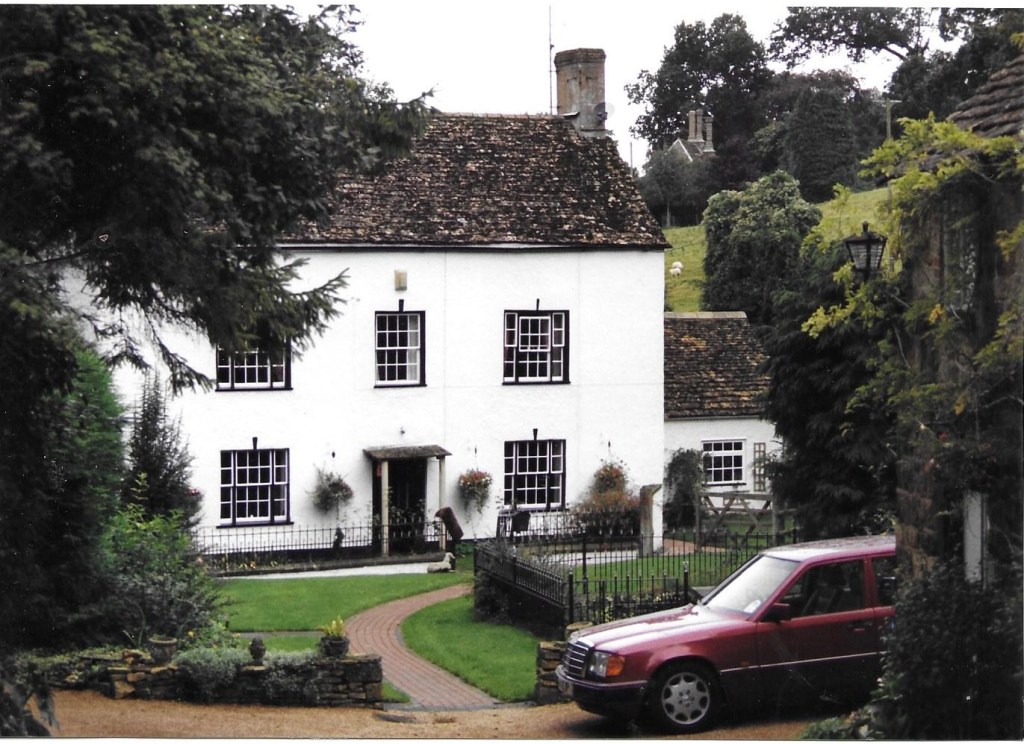
The mill house, past and present. In the present-day picture, with the workshops removed, the chimneys of Stancombe Lodge can be seen in the background.
The mill first appears on the Berkeley Estate map of 1762. It was called Lurrocks Mill, and was leased by Jonas Organ from the Berkeley Estate.
It then appears on the 1798 Catalogue of the Nibley Estate Sale, as Lot III, ‘particularly recommended to the attention of Manufacturers, there being a constant supply of water to the mills, and with which an extensive manufactory may be carried on, and having a good road leading to it.‘
The lot is outlined in orange on the map, and included a ‘A messuage and garden, with a duffell mill, and a grist mill’.
It was in the possession of Mrs Gazard, and bought by Mr Gazard for £300.

reproduced with permission from the National Library of Scotland
Gazards Row, or Rank, were built sometime before their appearance on the 1841 Census, perhaps the same time as the mill, which English Heritage date at circa 1820.

Gazards Row would originally formed a complete terrace. Note the front door, now below road level.
So, sometime before 1847, the area was bought by Sarah Poulton. It’s hard to disentangle the story of Sarah and her nephew from Gazards Row and Mill, so I apologise to the reader who doesn’t find them as interesting as I do.
Sarah was the daughter of James Ricketts, a wealthy landowner living at Cape Hall Farm in Frocester. In his will, written in 1817, he leaves Sarah a large inheritance of £1600. However, almost immediately after she married in 1819, he added a very long and strongly worded codicil to his will to the effect that none of that money was to reach her husband, Thomas Poulton. Control of her bequest was put into the hands of her brothers. There’s a strong possibility that he feels that Thomas (who was 11 years younger than Sarah) was a fortune hunter, reinforced by the fact that they married by licence, meaning that Banns did not have to be called, and none of the family signed as witnesses.
When Thomas Poulton died, in 1851, there is no mention of Sarah in his extensive will.
What happened over the next two decades is a mystery, but in 1841, Sarah is living with (or maybe just visiting) her brother at what has now become Kipe Hall (previously Cape Hall Farm). At some point before 1847, Sarah buys the mills and the terrace.
The terrace can be seen on the 1847 Tithe map – a terrace of 12 houses ending, at the western end, by a larger house, built for the workers at the adjacent mill. The occupiers are given below. From 1841 onwards, there never seems to have been a point when all houses were occupied, so now the terrace presents a rather more gappy appearance than it would have originally, as empty house fell down or were demolished.
Occupiers of Gazards Row in 1847
Bold indicates that the individual was living there in the 1841 Census
91 Robert Woodward
92 Sarah Bruton
93 Isaiah Jellings
94 John Allan
95 George Gabb
96 John Smart
97 James Widigore
98 Richard Trotman
99 Thomas Sparkes
100 Richard Trotman
101 Thomas Sparkes
102 Thomas Cole
Sarah Poulton let a piece of pasture land, but also a mill, garden, brooks and pool to her nephew, Edward Ricketts Long. The mill leat and buildings had disappeared by the time of the first OS map, but they lay to the south east of Gazards Row, marked on the map. The mill that we see today was listed, in 1847, as a house, two gardens, yard buildings and pond, and was owned and occupied by Sarah Poulton herself.
In 1851, Sarah was living with Edward, who was described as a master miller. Edward, born plain Edward Long, was the only child of her sister Jane, who had married Samuel Long who farmed in a small way (owning 8 acres) at Bradley Green, Wotton under Edge. Again, Jane was 19 years older than her husband, and he seems to have been of a lower social standing, so one wonders what was happening here. Sarah appears to have taken Edward on, as she was childless herself, and he becomes Edward Ricketts Long.
It seems probable that Edward was operating both mills at this time. At the time of the ’61 Census, Edward, now married, was living at the mill – now called Long’s Mill – with his wife. Sarah is living next door. Edward is listed as a miller, employing 8 men and a boy. Nearby lives Edmund Banfield and his family, also a miller, so perhaps Edward was only nominally running the business.
Sarah died in 1863. The trustees of her will were her nephews Thomas Ricketts of Claypits Villa, Eastington, Thomas Ricketts of Frocester, and Edward Ricketts Long of Nibley, who would administer the estate until Edward’s son, Albert Ricketts Long, reached 21. There was also a legacy for the personal use of Eliza Long, Albert’s sister. There are also legacies to other nephews and nieces.
Sarah stated that she was entitled to a mortgage debt of £1,500 secured on premises at NN, which she gave and bequeathed the same to her trustees to pay to Albert to returns for his natural life, from 25.
Albert was also bequethed ‘my clock and case linen china glass plate beds mattresses chest of drawers two chests trunk full of linen and all other my furniture of every description. And I give my wearing apparel to Harriett the wife of Edward Ricketts Long and I give £100 to the Society of Promoting Christianity among the Jews. £50 to the Orphan House in Bristol under the direction of Messrs Craig and Muller. £50 Wesleyan Missionary Society in London. £100 to be invested in funds in the names of Thomas Morse of Ashmeads, Thomas Ricketts of Frocester and Thomas Ricketts to be paid for the benefit of the deserving poor of Coaley, whether receiving parochial relief or otherwise in coal blankets or garments.‘
At this time Eliza and Albert were 8 and 7 years old.
The will was witnessed by Isaac Bennett, farmer, and George Humphries, miller and, only 2 years later, Isaac (‘the nearest friend of the plaintiffs’) bought a case in Chancery against Thomas and Edward Ricketts Long, presumably for maladministration of the estate.
As a result of the case, this advertisement appeared in the Gloucester Journal of 14th September 1867.
In Chancery
Ricketts vs Long
To be sold by auction 30th September 1867
Valuable Freehold Property, consisting of 10 freehold stone and brick-built cottages, with gardens to the front and rear..situate in NN..2 pieces of excellent freehold pasture land, part thereof orchard, containing 2 acres and 2 rods, a capital freehold overshot grist mill, with 2 pairs of stones, and an excellent dwelling house and stable and outbuildings with garden and orchard containing about 40 perches, and a capital piece of pasture land, 15 perches, at Nibley Green, awarded under the Nibley Enclosure Act.
In ’71, Edward was living with his children in Rose Cottage, near the mill. He has now turned to farming, and is recorded as a farmer of 108 acres. Poor Albert and Eliza are still only 16 and 18, and it must have been strange, to say the least, to live with a father when you had been on opposite sides of a court case only 4 years previously. In ’81 and ’91, there is no reference to the Row. In ’91 Hannah Long (no relation of Edward) is living in Longs Mill House.
In the ’91 Census, Edward is living with Alfred Trotman, as a servant. Alfred’s mother, the widowed Rebecca Trotman (nee Millard) lived nearby with her other son, Arthur William. Edward left generous legacies to both boys in his will, in 1899, and there is a strong possibility that at least Alfred, and possibly Edward, were his illegitimate sons.
By another sudden burst of fortune, in 1900 Edward bought Standle Farm in Uley, with 109 acres for £2500 plus £285 for the timber, and, later that year, died. He was recorded as living at Hengaston, Cam, and left £21,827 16s.
In ’01 there is Gazards Row, and a Mill House, lived in by Henry Long, a preacher.
Eliza married Arthur Jotcham, of a family still well known in Wotton, where she lived until her death in 1940.
Albert has a sadder story.
In 1875 he married Annie Fry and they were living with their 4 children at the Old House, Stinchcombe Lane. He is recorded as being a farmer of 50 acres. After that, he appears to have moved to Blagdon Farm, in Somerset, as he was reported as being the owner when it went into liquidation on that date.
In 1882, Albert, recorded as a labourer and living in Dursley, was imprisoned for 3 months for neglect of his 4 children, Edward (1875), Sarah (1877), Ernest (1878) and Frederick (1879). He was widowed, and living with his ‘2nd wife’ Malinda, who had a record of theft and drunkenness. Ernest had almost starved to death before action was taken.
Later, in 1883, the Bristol Mercury reported that Albert was imprisoned for 3 months with hard labour. He had been living In Newport with his children and had absconded, and later sent a man with a van to collect the furniture. The children, 2 of whom had measles, were left on the charge of the parish. He was later found living with a woman of loose character in Gloucester.
The children, when they appear in the next census, were boarded with Samuel Long and his family. In his will, written two decades later, Edward left £50 to Sarah Caroline Derrett, Samuel’s daughter ‘in recognition of her father’s kindness to me’. Large legacies were left to all four children, and the children of Eliza.
At the sale of property in 1867, it seems that it was bought by Edward, as he left ‘my old cottages and buildings in the row and above the passage through the said row on the right hand side and nearest to the lane leading to Park Farm’ to Arthur William Trotman’. The other end was left to Arthur’s brother, Alfred Ernest Trotman.
In 1891, Albert remarried and was living in Brunswick Square, Gloucester in 1901. He was described as living on his own means. Both Sarah and Edward provided funds for his support in their wills, which is probably what he was living on. However, in his father’s will, it was stipulated that the fund be in the absolute control of the executors. In 1911, he and his wife were living in Monmouth with their two children, William and Jane. He died in 1925, leaving £779 12s 8d, and gave probate to his brother in law, Arthur Herbert Jotcham.
I leave this information without comment, except to say that the past truly is another country. It’s unfortunate that only unhappy stories appear in newspapers, so this can’t be balanced with something more about Eliza’s life.
But, if anyone can help me with more information about either the buildings round and about the mill, or information about the individuals, I would be pleased to add it to my record. My email address is westridgenn@gmail.com
 North Nibley One-Place-Study