Sarah (1832-1899)
Solomon (1834-
Eliza (1837-1885)
Dinah (1838-1890)
In 1841, the family – the individuals listed above, and the four older siblings – were living in Howley, in the property circled in blue in the map below. Their parents were Jacob and Elizabeth, nee Millard, aged 31 and 41. Jacob is listed as a labourer in ’41, though as a handloom weaver in the next census, and elsewhere as a spinner. Living away from home was William, born in 1823.
However, Jacob Webb also occupied number 484, circled in pink. One of those mysteries that hopefully will get sorted out at some point. Jacob also occupied a garden, circled in yellow, taken from the Waste and Common Land.

Reproduced by the permission Geoff Gwatkin
All the children in the family were baptised at St Martins church, in the village. But an elder sister, Rhoda, was admitted to the Methodists in Wotton under Edge, but later excluded for bad behaviour.
In 1851, Jacob (now a handloom weaver) and Elizabeth were living in Nibley, with Rhoda (also a handloom weaver), Sarah, Eliza, Dinah, and Solomon (a cloth worker).
Elizabeth died four years later and, two years after that, Jacob (then living on Bradley Road, Wotton under Edge) married Eliza Smith, also widowed. In ’61, he is living with Eliza, her two daughter from her previous marriage (with their surname changed to his) and his new son, Osbourne. In ’71, Jacob is again widowed, and living with his son Osbourne and two step daughter. Despite the collapse of the woollen industry in the area, all four of them and employed in it – as a woollen cloth weaver, a wool beater , and woollen cloth burlers. Jacob died six years later, in 1877.
In 1861 Sarah was a servant, living in Stroud. In April 1871, she married Alfred William Voyce, a porter and eight years her junior, in St Katherine’s church, Gloucester. In 1881, the couple are living on St Katherine Street, Gloucester. Alfred is now a brewer, and Sarah a ‘late servant’.
William died in 1886 and, in ’91, Sarah is widowed, working as a laundress. She is still living on St Katherine Street (in a two room house) with her son, William, a carpenter and joiner. Sarah died in 1899.
In 1858, Eliza married Edwin Mann. As can be seen below, both were illiterate.
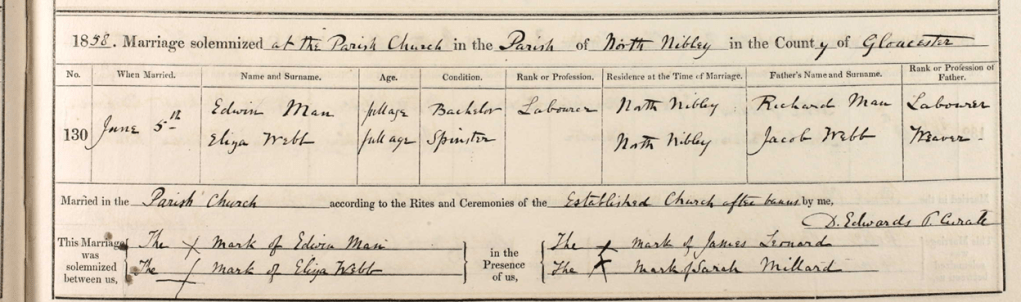
In ’61 they were living in Comb, Wotton under Edge, with their first two children, aged 2 years and 11 months. The eldest child, Amelia, later married her cousin. Eliza was a cloth worker. Eliza had nine children in all, and lived in Comb until her death in 1885, aged 49. Edwin died in 1898.
I can’t find Dinah on the ’61 Census, but she had an illegitimate child, Mary Jane Webb, who was christened in Sherston Magna in May 1864. In her record of marriage, in 1884, her father is recorded as being William Morris.
The next year, Dinah married William Morris, again in Sherston. But – in ’61, William was living with his son, Henry, and a housekeeper, Elizabeth Webb, born 1836 in Wotton under Edge. Who I suspect is Dinah, with a name change.
In ’71, William, recorded as married, is living with Henry, and three children from his relationship with Dinah, including Mary Jane. Dinah/Elizabeth was in prison.
From the North Wilts Herald 1st April 1871
STEALING FLOUR AT SHERSTON
Mary Sparrow (16) was charged with stealing 55lb of flour, valued 3s 9d, the property of Michael Blake, at Sherston Magna…and Elizabeth Morris (27) was charged with receiving the same, knowing it was stolen. Sparrow pleaded guilty and Morris not guilty – The prosecutor is a farmer residing in Sherston Magna, and Sparrow was a servant in his employ. On the day mentioned the woman Morris went into the prosecutors house and met Sparrow, who gave her a bag of flour, for which she received 2s, the actual value of the flour being 3s9d. Morris having received the flour, put it under her apron and was quitting the premises, when she met one of the labourers on the farm. Having his suspicions aroused, the man took the flour away from her and handed it to his master – the prosecutor stated that his servant (Sparrow) had evidently been led away by the woman (Morris) as the girl herself had been a good servant. He recommended Sparrow to the mercy of the Court. The learned judge censured the conduct of Morris, and sentenced her to six month’s imprisonment.
In 1881, William is living with Elizabeth, William, who appears in the previous census, and 3 more children – Thomas, Walter and Sarah. When William and Sarah Ann appear in the next census, they are living in Monmouthshire with their elder sister, now married, Sarah Jane. All three younger children were baptised together, several years after their births, on 6th September 1885.
No death record can be found for William or Dinah. But Elizabeth Morris, born 1837, was buried in Sherston in 1890, so I think this is probably Dinah. Two William Morris’ died in the 1890s, but, without buying the certificate, I don’t know which one is him.
In 1857, in Machen, Monmouthshire, a sinker, married Hannah Pritchard – who, although listed as a spinster, seems to have been born Lovelock (see below)
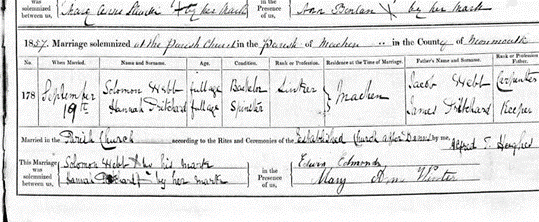
The Sinkers were a separate group of miners who were willing to take the risk of being first one to go down new mine shafts once they reached coal seams. Initially they used basic tools such as shovels and picks to remove the stone that had to be broken to reach the coal seam.
In 1851, Hannah was a servant in Sherston Magna, where Dinah/Elizabeth lived, and where she could have met Solomon.
In 1861, Hannah was visiting her parents, William and Charlotte Lovelock, with her two-year-old daughter Rhoda, in Lyneham.
In October, 1861, Solomon was imprisoned for 3 months for larceny, for stealing another man’s boots.
Four years later, he was called to give evidence at a fatal accident
from the Cardiff and Merthyr Guardian, Glamorgan, Monmouth and Brecon Gazette
9th May 1868
FATAL ACCIDENT ON THE CARDIFF AND CARPHILLY RAILWAY
An accident was caused at Carphilly, by the falling of a skip, in which seven men, down a shaft nearly 120 yards deep, causing instantaneous death to all of them.
This was in the progress of building a tunnel for the railway, which required several shafts to be sunk.
Solomon Webb, a banksman in the employment of Messr Logan and Co said: ‘My duty is to land the skip and see that it is clear of the lorry when it goes down. I gave the orders for the enginemand to lower the skip or raise it. It did not consider it was a fit place for Jabex Price to stand in when the skip was being lowered to the bottom, and when it reached him I called to him to get in, and to come to the top. He did so; and the engine brought it up sufficanlty near for Price to get out, but before he could do so the skip went down. In about four or five seconds the skip struck the bottom of the shaft. The wire rope broke off near the drum, and a small piece of it flew into the air. In a short time a ganger from the next shaft came and volunteered to go down. ..Two men descended ..Soon after all the dead bodies were brought to the surface.
Hannah was living in Hendredenny, South Wales, in 1871, with four children. On the form, Solomon was listed as ‘absent – a pit banksman’. This was someone at the pit top or surface who was responsible for loading and unloading the cage, lowering and raising of materials and personnel up and down the shaft and signalling to the engineman.
In 1881, the family, with three children living at home, are in East Dean. Solomon has no occupation, but their eldest son, aged just 13, was a coal miner.
On 27th April, 1888, Solomon and Hannah Webb emigrated from Liverpool, England, aboard “The Queen.” The ship stopped at Queenstown, Ireland before going on to New York.
In the 1890 Census for Snowshoe, Pennsylvania, the widowed Hannah was living with her son and his family, so Solomon must have died soon after he migrated to the States.
 North Nibley One-Place-Study